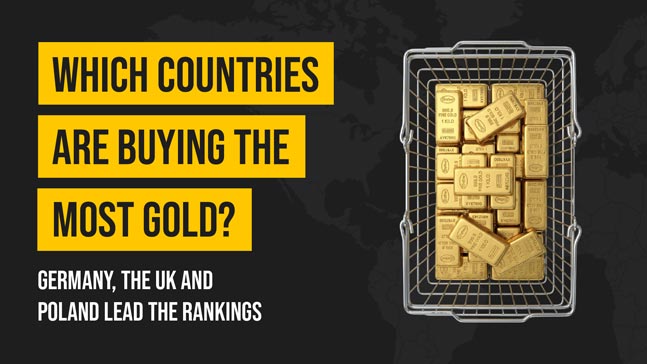
When the news feels uncertain, many people start to think about gold. If you keep an eye on the gold price or are thinking about whether to buy gold yourself, you may have wondered where in the world people buy the most of it.
Our latest research has found some surprising results. Gold bar and coin investment in Germany surged by 166.7% in 2025, while Poland's central bank added 102 tonnes of gold to its reserves, worth an estimated $13.7bn (as of 6 October 2026).
We also look at the Middle East, a region at the centre of global attention in 2026. Below, you'll find the rankings for each measure and what they show.
Key takeaways
- Poland's central bank was the world's largest gold buyer in our study, adding 102 tonnes to its reserves, valued at approximately $13.7bn.
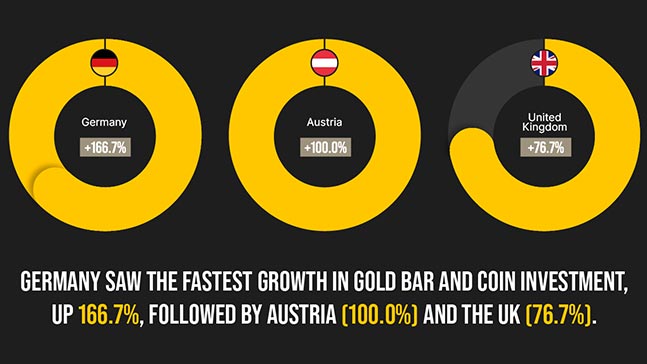
- Germany saw the fastest growth in gold bar and coin investment, up 166.7%, followed by Austria (100.0%) and the UK (76.7%).
- Austria showed the highest online search interest in gold investment, followed by Germany. The UK ranked fourth when searches were adjusted for population.
- Switzerland bought the most gold per person, at 2.75g in 2025, with Singapore, Kuwait and the UAE completing the top four.
Where people are investing the most in physical gold
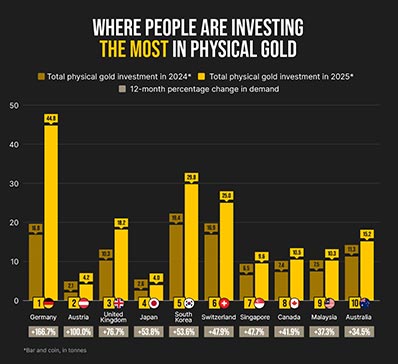
Germany recorded the largest percentage increase in gold bar and coin investment among the countries in our study in 2025, with demand rising by 166.7%. Austria and the UK followed, making Europe home to all three of the fastest-growing markets.
Among countries with comparable figures, mainland China was the largest market overall, with people buying 431.7 tonnes of gold bars and coins, an increase of 95.5 tonnes from 2024.
The table ranks countries by the percentage increase in physical gold investment, rather than the total amount purchased.
| Rank |
Country |
Total physical gold investment in 2024* |
Total physical gold investment in 2025* |
12-month percentage change in demand |
| 1 |
Germany |
16.8 |
44.8 |
+166.7% |
| 2 |
Austria |
2.1 |
4.2 |
+100.0% |
| 3 |
United Kingdom |
10.3 |
18.2 |
+76.7% |
| 4 |
Japan |
2.6 |
4.0 |
+53.8% |
| 5 |
South Korea |
19.4 |
29.8 |
+53.6% |
| 6 |
Switzerland |
16.9 |
25.0 |
+47.9% |
| 7 |
Singapore |
6.5 |
9.6 |
+47.7% |
| 8 |
Canada |
7.4 |
10.5 |
+41.9% |
| 9 |
Malaysia |
7.5 |
10.3 |
+37.3% |
| 10 |
Australia |
11.3 |
15.2 |
+34.5% |
*Bar and coin, in tonnes.
Gold investment in Germany almost triples, while Austria doubles its buying
German buyers purchased 44.8 tonnes of gold bars and coins in 2025, up from 16.8 tonnes the previous year. That's an additional 28 tonnes of gold in just 12 months, equivalent to 28,000 one-kilogram gold bars.
Neighbouring Austria recorded the second-fastest growth, with investment doubling from 2.1 tonnes to 4.2 tonnes. Although Austria's market is considerably smaller, both countries also recorded the highest levels of online search interest in gold investment, placing them at the forefront of two of our rankings.
The strong growth wasn't confined to Europe, either. Japan and South Korea saw demand increase by 53.8% and 53.6%, respectively, while Switzerland recorded a 47.9% rise.
UK gold investment jumps 77%, the third-fastest increase worldwide
British buyers purchased 18.2 tonnes of gold bars and coins in 2025, compared with 10.3 tonnes the year before. That's a 76.7% increase, putting the UK behind only Germany and Austria for growth in physical gold investment.
Despite this sharp rise, the UK ranks much lower in physical gold investment per person. Across the UK's population, that works out at physical gold investment equivalent to just 0.26g per resident, compared with 2.75g in Switzerland, the highest figure in our study.
There's plenty of online interest in gold investment, too. Our Google search analysis found that "gold bars" was the UK's most-searched gold investment term, attracting 372,800 searches.
Gold buying falls in Turkey and the US despite growth across most markets
While gold investment increased across most of the countries we studied, Turkey recorded the biggest fall in the amount purchased. Demand dropped by 41.1 tonnes in 2025, although the country remained the third-largest market for gold bars and coins behind mainland China and India.
The US recorded the next-largest decline, with investment falling 20.4% from 77.5 tonnes in 2024 to 61.7 tonnes in 2025.
Vietnam (-14.3%), Mexico (-12.5%), and Egypt (-1.7%) were the only other markets in our comparable dataset to record declines.
Where interest in buying gold is highest
| Rank |
Country |
Total gold-related searches |
Gold-related searches per 100,000 people |
| 1 |
Austria |
360,160 |
3,911.3 |
| 2 |
Germany |
2,607,430 |
3,123.0 |
| 3 |
Singapore |
110,510 |
1,808.3 |
| 4 |
United Kingdom |
1,008,000 |
1,450.6 |
| 5 |
Switzerland |
125,660 |
1,382.0 |
| 6 |
Australia |
379,560 |
1,374.5 |
| 7 |
United Arab Emirates |
105,630 |
917.5 |
| 8 |
United States |
3,114,000 |
911.1 |
| 9 |
Canada |
376,910 |
904.9 |
| 10 |
Taiwan |
207,420 |
892.4 |
Austria recorded the highest search interest in physical gold investment among the countries in our study, with 3,911 searches per 100,000 residents across the investment-related terms we analysed. Germany follows with 3,123, putting the same two countries that saw the biggest rises in physical gold investment at the top of the search rankings.
Singapore takes third place, while the UK ranks fourth with 1,451 searches per 100,000 people, narrowly ahead of Switzerland.
The rankings change when we look at total searches rather than searches per capita. The US recorded around 3.1 million searches, more than any other country studied, but ranks eighth after accounting for its much larger population. The UAE is the highest-ranking Middle Eastern market, placing seventh.
The countries adding the most gold to their reserves
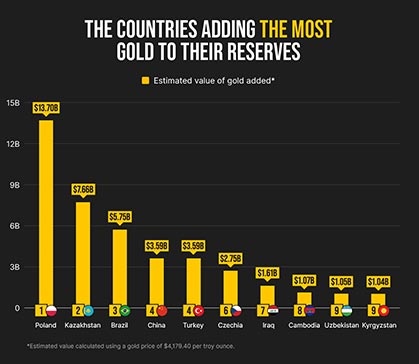
Poland recorded the largest increase in central bank gold reserves in our 2025 study, adding 102 tonnes to its national holdings.
While some countries were building their stockpiles, others reduced theirs. Singapore recorded the biggest decline, with its central bank holdings falling by 26.4 tonnes.
| Rank |
Country |
Gold reserves
in 2024* |
Gold reserves
in 2025* |
Net change
in gold
reserves* |
Estimated
value of
gold added** |
| 1 |
Poland |
448.2 |
550.2 |
+102.0 |
$13.7bn |
| 2 |
Kazakhstan |
284.1 |
341.0 |
+57.0 |
$7.7bn |
| 3 |
Brazil |
129.7 |
172.4 |
+42.8 |
$5.7bn |
| 4 |
China |
2,279.6 |
2,306.3 |
+26.7 |
$3.6bn |
| 5 |
Turkey |
587.6 |
614.3 |
+26.7 |
$3.6bn |
| 6 |
Czechia |
51.2 |
71.6 |
+20.4 |
$2.7bn |
| 7 |
Iraq |
162.6 |
174.6 |
+12.0 |
$1.6bn |
| 8 |
Cambodia |
46.5 |
54.4 |
+8.0 |
$1.1bn |
| 9 |
Uzbekistan |
382.6 |
390.4 |
+7.8 |
$1.0bn |
| 10 |
Kyrgyzstan |
38.1 |
45.9 |
+7.7 |
$1.0bn |
*Net change in official gold reserves, in tonnes. **Estimated value calculated using a gold price of $4,179.40 per troy ounce.
Poland adds 102 tonnes of gold to its reserves, worth an estimated $13.7bn
Poland added 102 tonnes of gold to its national reserves in 2025, more than any other country in our study. To put that into perspective, the increase alone is equivalent to 102,000 one-kilogram gold bars (based on gold prices as of 6 October 2026).
Poland's increase was considerably larger than those of Kazakhstan and Brazil, which recorded the next-biggest additions at 57 tonnes and 42.8 tonnes respectively. Czechia also increased its reserves by 20.4 tonnes, placing it sixth in the rankings.
For the longer-term picture of how Poland and other countries have built up their gold, see our 2026 Gold Nations Report.
Czechia records the fastest percentage growth in national gold reserves
Czechia increased its gold reserves by 39.9% in 2025, the fastest percentage growth among countries that held at least 10 tonnes of gold at the start of the year.
Its central bank added 20.4 tonnes to its official gold reserves, worth an estimated $2.7bn, placing it sixth in terms of the amount added. Brazil followed with a 33.0% increase in reserves, while Poland recorded a 22.8% rise.
The rankings give a different perspective from the total amount bought. Poland added far more gold, but Czechia recorded the greater percentage increase.
The countries holding the most gold
The United States remains the largest official holder of gold in our study, with 8,133.5 tonnes in its reserves. That's almost two and a half times Germany's holdings and accounts for almost a quarter (24.7%) of the 32,986.8 tonnes held across the countries analysed.
Germany ranks second, followed by Italy and France. Together with the US, these four countries account for almost half (49.6%) of the gold reserves in our dataset.
However, the amount of gold a country owns tells only part of the story. Gold makes up 81.4% of the US's total reserves, compared with just 8.1% in China, despite China holding the world's fifth-largest gold stockpile.
| Rank |
Country |
Gold holdings* |
Gold as a share of total reserves |
Estimated value of gold holdings |
| 1 |
United States |
8,133.5 |
81.4% |
$1,092.9bn |
| 2 |
Germany |
3,349.5 |
81.0% |
$450.1bn |
| 3 |
Italy |
2,451.8 |
77.1% |
$329.4bn |
| 4 |
France |
2,437.0 |
78.5% |
$327.5bn |
| 5 |
China |
2,366.3 |
8.1% |
$318.0bn |
| 6 |
Russia |
2,276.8 |
41.3% |
$305.9bn |
| 7 |
Switzerland |
1,039.9 |
12.4% |
$139.7bn |
| 8 |
India |
880.5 |
16.2% |
$118.3bn |
| 9 |
Japan |
846.0 |
8.5% |
$113.7bn |
| 10 |
Poland |
640.2 |
28.2% |
$86.0bn |
*Official gold holdings, in tonnes. Figures reflect the latest available data as of 6 October 2026.
US gold reserves are worth an estimated $1.09tn, the highest worldwide
The United States holds an estimated $1.09tn worth of gold in its official reserves, far ahead of any other country in the study. Its 8,133.5-tonne stockpile is more than double Germany's 3,349.5 tonnes, which puts Germany in second place.
Gold also accounts for a particularly large share of both countries' total reserves. In the US, the figure is 81.4%, while Germany is close behind at 81.0%. They are the only two countries in the top 10 where gold represents more than 80% of reserve assets.
Poland enters the world's top 10 gold holders, overtaking the Netherlands
Poland has entered the world's top 10 official gold holders, with 640.2 tonnes of gold worth an estimated $86bn, according to the latest figures available as of 6 October 2026. It now sits ahead of the Netherlands, which holds 612.5 tonnes.
Poland's place in the rankings is especially significant alongside its recent buying activity. Having added more gold than any other country in our 2025 purchasing analysis, it now holds one of the world's 10 largest national stockpiles. Gold also accounts for 28.2% of its total reserves.
Spotlight: Gold buying in the Middle East
The Middle East is home to some of the world's largest buyers of physical gold per capita. Kuwait and the UAE both rank among the top four markets for gold bar and coin investment per person, alongside Switzerland and Singapore.
Our research also reveals a difference between households and central banks across the region. While gold investment among consumers increased in several Gulf countries during 2025, most of their central banks made little or no change to their gold reserves.
The figures cover the period before the latest US-Iran conflict began, providing a picture of the region's gold investment activity prior to the escalation. Turkey has also been included in the regional comparisons.
Kuwait and the UAE rank among the world's four biggest gold buyers per person
| Country |
Total physical gold investment in 2024* |
Total physical gold investment in 2025* |
12-month percentage change in demand |
| Kuwait |
6.1 |
6.7 |
+9.8% |
| United Arab Emirates |
13.5 |
14.8 |
+9.6% |
| Turkey |
112.2 |
71.1 |
-36.6% |
| Iran |
42.3 |
46.2 |
+9.2% |
| Saudi Arabia |
15.5 |
17.6 |
+13.5% |
| Egypt |
24.0 |
23.6 |
-1.7% |
*Total bar and coin investment, in tonnes. Figures cover calendar years 2024 and 2025.
Kuwait and the UAE rank third and fourth worldwide for the amount of physical gold purchased relative to population. In 2025, bar and coin investment amounted to 1.38g per resident in Kuwait and 1.29g in the UAE, behind only Switzerland and Singapore.
Demand also increased across the Gulf. Of the three Gulf countries compared, Saudi Arabia recorded the biggest increase in gold bar and coin investment, with demand rising by 13.5%. Kuwait followed with a 9.8% rise, while the UAE recorded 9.6% growth.
Elsewhere in the region, Iran recorded 46.2 tonnes of physical gold investment, up 9.2% on 2024. This makes it the seventh-largest market by volume across our full study, ahead of Germany. Turkey's purchases declined by 36.6%, although its 0.83g per-person figure remains relatively high compared with other countries in the regional analysis.
Online interest was also particularly high in the UAE, which ranked seventh worldwide for gold investment searches per capita. As in the UK, "gold bars" was the country's most popular search term, attracting 64,200 searches.
Iraq increases its gold reserves by 12 tonnes as Gulf central banks make few changes
| Country |
Gold reserves in 2024* |
Gold reserves in 2025* |
Net change in gold reserves* |
Percentage change in gold reserves |
| Iraq |
162.6 |
174.6 |
+12.0 |
+7.4% |
| Qatar |
110.8 |
115.2 |
+4.4 |
+4.0% |
| Egypt |
126.9 |
129.4 |
+2.5 |
+2.0% |
| Jordan |
71.7 |
72.9 |
+1.2 |
+1.7% |
| United Arab Emirates |
74.4 |
74.5 |
+0.1 |
+0.1% |
| Kuwait |
79.0 |
79.0 |
0.0 |
0.0% |
| Saudi Arabia |
323.1 |
323.1 |
0.0 |
0.0% |
| Libya |
146.7 |
146.7 |
0.0 |
0.0% |
| Bahrain |
4.7 |
4.7 |
0.0 |
0.0% |
*Official gold reserves and net changes, in tonnes.
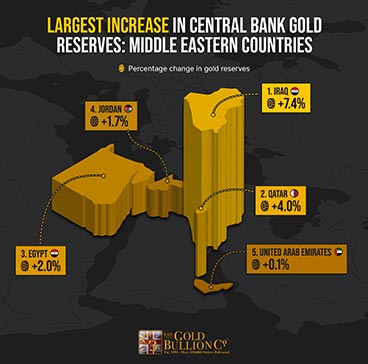
Iraq recorded the largest increase in central bank gold reserves among the Middle Eastern countries in our study, adding 12 tonnes in 2025. The additional gold had an estimated value of $1.6bn and represented a 7.4% increase in its national gold holdings.
Elsewhere in the region, changes were much smaller. Qatar added 4.4 tonnes, while Egypt and Jordan increased their reserves by 2.5 tonnes and 1.2 tonnes respectively. Gold holdings in the UAE, Kuwait, Saudi Arabia, Libya and Bahrain changed very little.
Saudi Arabia provides an interesting comparison with the household investment figures. Although consumers increased their gold bar and coin purchases by 13.5%, the country's central bank made no additions to its 323.1-tonne stockpile during the year.
How has conflict in the Middle East affected gold buying in 2026?
Turkey's central bank sold gold and entered into gold swap agreements during March 2026, as authorities sought to stabilise financial markets following the outbreak of conflict involving Iran. By the end of August, World Gold Council figures indicated that Turkey was a net seller of 82 tonnes of gold for the year.
Household investment in the UAE has followed a different direction. According to the World Gold Council, demand for gold bars and coins in the UAE in the second quarter of 2026 increased by 30% year-on-year.
These developments took place after the period covered by our main study. They provide additional context for how differently gold markets can respond to geopolitical events, with Turkey drawing on its reserves while physical gold investment increased among buyers in the UAE.
Why are countries buying so much gold? The Gold Bullion Company's expert explains
With European countries recording some of the biggest increases in both personal gold investment and central bank purchases, we asked The Gold Bullion Company's expert for their view on what's behind the interest in gold and what buyers should keep in mind.
Rick Kanda, Managing Director of The Gold Bullion Company, comments:
“What stands out from this study is how quickly gold investment increased in several European countries in 2025. Poland's central bank added more gold than any other country in our study, while demand for gold bars and coins grew fastest in Germany, Austria and the UK.
“Central banks hold gold because it is not tied to any one government or currency. Global conflict tends to strengthen that case, but it can affect reserves in more than one way. A country may build its gold holdings to protect itself against shocks. When pressure arrives, gold can also be one of the few assets that can be converted into cash quickly, as we saw in Turkey earlier this year. Both come from the same idea: gold is there to provide stability when it is needed.
“The principle is similar for individuals. If you are considering buying gold, work with an established dealer, check the premium you are paying over the gold price, and think about it as a long-term holding rather than a short-term trade.”
Why trust us
The Gold Bullion Company was established over 30 years ago and has been helping customers buy and sell precious metals ever since. As an official partner of The Royal Mint and an authorised distributor for leading bullion producers, we have extensive knowledge of the gold market and the factors that can influence buying decisions.
Our research uses data from established sources, including the World Gold Council and World Bank, alongside our own analysis of Google search trends. We explain our sources and calculations below so readers can see how we reached our findings.
Methodology
At The Gold Bullion Company, we regularly follow changes in gold prices and investment trends to help buyers better understand the precious metals market.
For this study, we wanted to find out where interest in gold is growing fastest, which countries are investing the most in physical gold, and how central banks are changing their reserves.
Countries investing the most in physical gold
We used 2024 and 2025 calendar year data from the https://www.gold.org/goldhub/data/gold-reserves-by-country..
For each available country, we collected the quarterly totals for bar and coin investments and summed them over the four quarters of 2024 and 2025.
Note: The World Gold Council defines total bar and coin investment as the net investment in physical gold bars, official bullion coins, and medals/imitation coins. So this shows physical gold investment rather than investments like gold ETFs, funds or mining shares. Read more about the World Gold Council's notes and definitions.
We calculated:
- Total physical gold investment: total bar and coin demand over the latest 12 months, in tonnes.
- Physical gold investment per capita: we converted tonnes to grams and divided it by the country's population.
- 12-month change in demand: latest 12 months minus the previous 12 months, in tonnes.
- Percentage change in demand: percentage increase/decrease between the two 12-month periods.
For per capita figures, we used https://data.worldbank.org/indicator/SP.POP.TOTL.
Countries with the greatest search interest in gold investment
We used Google Ads Keyword Planner to find the number of searches between September 2025 and August 2026 specifically related to physical gold investment.
We used a fixed list of search terms:
- buy gold
- buy gold bars
- gold bullion
- gold bars
- buy gold coins
- gold investment
For non-English-speaking countries, we translated the terms into the main local language.
We then summed the volumes across all search terms and calculated per 100,000 people.
Countries stockpiling the most gold
We analysed changes in reported official gold reserves between the end of 2024 and the end of 2025, using the World Gold Council's gold reserves by country dataset.
We calculated the net change in official gold reserves by subtracting each country's holdings at the end of 2024 from its holdings at the end of 2025, then ranked countries by the largest increase.
Note: Figures may vary between World Gold Council datasets due to differences in data sources, reporting methods and adjustments to official gold holdings. This can particularly affect countries such as Turkey, where specific adjustments are made to account for gold held under commercial banking arrangements. For more information, see the World Gold Council's methodology and technical adjustments.
Increase in gold reserves
For each country, we calculated the percentage increase in gold reserves.
We only include countries that held at least 10 tonnes of gold at the beginning of the period.
Estimated value of gold added
We estimated the value of each country's net increase in gold reserves between the end of 2024 and the end of 2025, using the gold price as of 6 October 2026.
We used the https://www.gold.org/goldhub/data/gold-prices to calculate:
Net tonnes added × 32,150.7466 troy ounces per tonne × gold price per troy ounce.
Current gold reserves
Using the same World Gold Council reserve dataset, we recorded the following for each country using the latest data available. This is accurate as of the 6th of October 2026.
- Total official gold holdings, in tonnes
- Value of gold holdings
- Gold as a percentage of total international reserves
All data was collected in October 2026 and is correct as of then.