The 2026 Gold Nations Report: Which Countries Hold the Most Gold and Why It Matters
Gold as a commodity is becoming increasingly valued worldwide. In April 2025, the average gold price was $76.9m per tonne, but it had risen to $156.3m per tonne by April 2026, a 103% increase.
Gold continues to strengthen its position as a global safe-haven asset, with rising demand influencing investor behaviour. As more individuals look to buy gold coins and central banks stock up on gold reserves, understanding national reserves offers valuable market context.
We have updated the Gold Nations Report, incorporating the latest available data and updated valuations. Since 2023, shifts in the gold price have significantly altered the estimated worth of global reserves.
By revisiting the world’s largest gold-holding nations, this report highlights how reserves have evolved. Revealing which countries are increasing their gold reserves, and how global gold prices are impacting countries' reserves.
Key takeaways
- The United States remains the world’s largest gold holder, with 8,133.5 tonnes.
- While reserves have largely stagnated, their value has surged dramatically, with US holdings rising from $507bn to $897.3bn due to the sharp increase in the gold price.
- The Czech Republic recorded the fastest growth, increasing its gold reserves by 144.5%, the largest percentage rise of any country in the study.
- Poland led in absolute growth, adding 211.7 tonnes of gold since 2023, accounting for over a third of all gold acquired across the countries analysed.
The nations whose gold reserves have increased the most
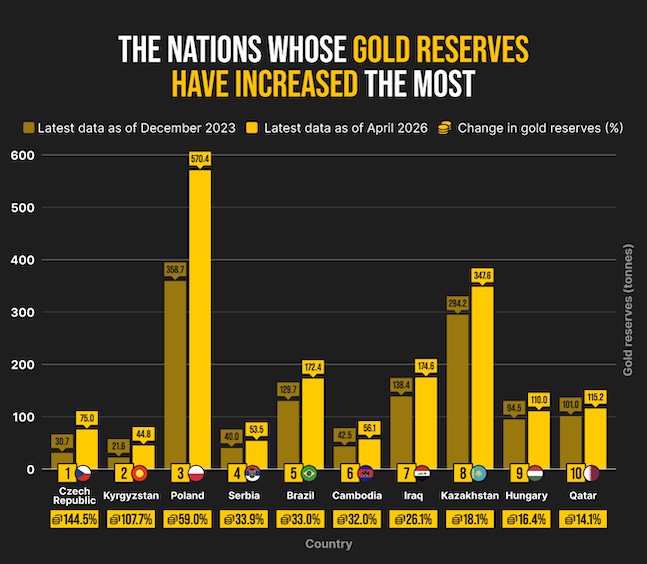
Overall, countries are increasing their gold reserves. Between the original study in 2023 and April 2026, the average nation’s gold reserves have increased by 6.47%. Only 16 countries have decreased their gold reserves, and 10 of these by fewer than 1%.
One reason nations are pursuing gold reserves is to diversify away from reliance on the US dollar, given recent instability in the currency and American foreign policy generally. This is also seen by large gold-holding nations such as France and Germany moving to repatriate their gold reserves from the US.
In total, 626.8 tonnes of gold were acquired by the countries in the study to increase their coffers. Over a third of this was acquired by Poland alone, and the Czech Republic saw the largest increase, at 144.5%. Eastern European nations and other former Soviet states feature prominently at the top of the rankings; six of the top ten are in this category. One reason they are buying gold is to protect against potential external economic shocks stemming from geopolitical tensions and conflict in the region.
Gold reserves (tonnes)
| Rank |
Country |
Latest data as of December 2023 |
Latest data as of April 2026 |
Change (%) |
| 1 |
Czech Republic |
30.7 |
75.0 |
144.5% |
| 2 |
Kyrgyzstan |
21.6 |
44.8 |
107.7% |
| 3 |
Poland |
358.7 |
570.4 |
59.0% |
| 4 |
Serbia |
40.0 |
53.5 |
33.9% |
| 5 |
Brazil |
129.7 |
172.4 |
33.0% |
| 6 |
Cambodia |
42.5 |
56.1 |
32.0% |
| 7 |
Iraq |
138.4 |
174.6 |
26.1% |
| 8 |
Kazakhstan |
294.2 |
347.6 |
18.1% |
| 9 |
Hungary |
94.5 |
110.0 |
16.4% |
| 10 |
Qatar |
101.0 |
115.2 |
14.1% |
The Czech Republic records the largest global increase in gold reserves
- 2023 gold reserves (tonnes): 30.7
- 2026 gold reserves (tonnes): 75
- Percentage change: 144.5%
The biggest increase in gold reserves was seen in the Czech Republic, where reserves rose by 144.5% from 30.7 to 75 tonnes. This increase is far higher than the average change of 6.47%. In recent years, the Czech government has been aggressively purchasing gold and aims to carry on increasing its reserves toward 100 tonnes.
As a result of this increase, the Czech Republic’s gold reserves rank 43rd in the world, with an estimated value of $8.3bn.
Kyrgyzstan more than doubles its gold reserves
- 2023 gold reserves (tonnes): 21.6
- 2026 gold reserves (tonnes): 44.8
- Percentage change: 107.7%
The only other country which has more than doubled their gold reserves since the original study is Kyrgyzstan, the central asian nation has been looking to diversify its economy by increasing gold reserves.
With reserves increasing from 21.6 tonnes to 44.8 tonnes, Kyrgyzstan now ranks 52nd among countries in the study, with gold reserves valued at $4.9bn.
Poland leads in total gold accumulation across all nations analysed
- 2023 gold reserves (tonnes): 358.7
- 2026 gold reserves (tonnes): 570.4
- Percentage change: 59%
Poland has seen the third-largest increase in its gold reserves since 2023 and the largest absolute increase in gold tonnes. Since 2023, Poland has acquired 211.7 tonnes of gold and is now the 12th biggest holder of gold in the world, with 570.4 tonnes. These reserves are valued at $62.9b.
The head of the Polish Central Bank views increasing gold reserves as vital to securing the nation's financial stability and independence; as a result, Poland has been increasing its reserves.
The world’s biggest gold nations
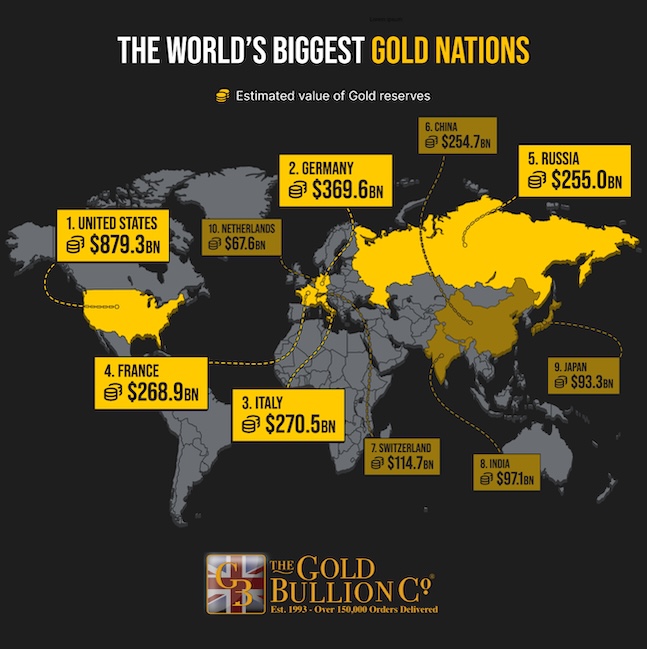
Whilst some countries have increased their reserves, others still hold much greater gold reserves. Despite aggressive buying by some countries, the same nations dominate the rankings. Across the 90 countries in the study, total gold reserves amount to 32,660.3 tonnes, with the vast majority held by a handful of countries, heavily concentrated in the West.
Just four countries hold 16,372.6 tons, or about half of the total reserves. The total estimated value of all these reserves is $3.6tn, averaging $40bn per country. And the US holds about 25% of the total global central bank gold. Europe is another heavyweight gold region. Among European Union countries, there is $1.25 trillion in gold reserves, $354 billion more than in the US, and gold has now overtaken the Euro to become the second largest reserve globally.
Due to the large increase in gold prices, the average price of each country’s gold reserves has risen, even though their actual reserves have not increased since the original study.
| Rank |
Country |
Gold reserves (tonnes) |
Gold reserves (oz t) |
Estimated value |
| 1 |
United States |
8,133.5 |
261,492,025 |
$897.3bn |
| 2 |
Germany |
3,350.3 |
107,712,145 |
$369.6bn |
| 3 |
Italy |
2,451.8 |
78,825,370 |
$270.5bn |
| 4 |
France |
2,437.0 |
78,349,550 |
$268.9bn |
| 5 |
Russia |
2,311.0 |
74,298,650 |
$255.0bn |
| 6 |
China |
2,308.5 |
74,218,275 |
$254.7bn |
| 7 |
Switzerland |
1039.9 |
33,432,785 |
$114.7bn |
| 8 |
India |
880.3 |
28,301,645 |
$97.1bn |
| 9 |
Japan |
846.0 |
27,198,900 |
$93.3bn |
| 10 |
Netherlands |
612.5 |
19,691,875 |
$67.6bn |
The United States still dominates global gold reserves by a wide margin
- Gold reserves, tonnes: 8,133.5
- Estimated value of gold reserves: $897.3bn
Just as they were three years ago, the United States still has by far the largest gold reserves of any country on the planet. In total, the United States has 8,133.5 tonnes of gold, which is almost double that of Germany in second place, and 2141.25% more than the average reserves across countries in the study, 362.9 tonnes.
Although the United States has not increased its reserves since the first study, the value of its gold reserves has massively risen from $507bn to $897.3bn. This is a result of the rapid increase in the price of gold, which has more than doubled between 2023 and 2025.
Germany retains second place despite a slight drop in gold holdings
- Gold reserves, tonnes: 3,350.3
- Estimated value of gold reserves: $369.6bn
Despite Germany's gold reserves dropping slightly, the value of its gold has increased since the first study. Currently, Germany's gold reserves are 3,350.3 tonnes, 2.7 tonnes fewer than in 2023. Interestingly, over a third (1,236 tonnes) of Germany’s gold is stored in vaults in the United States, with some German economists advocating its repatriation.
Just like the United States’, Germany’s gold reserve value has increased massively due to the jump in the price of gold since the first study. Previously, the German gold reserves were worth $209bn, but this has increased by 75.8% to $369.6bn. This is 824% higher than the average country's gold reserves of $40bn.
Italy holds firm in third as reserves remain unchanged
- Gold reserves, tonnes: 2,451.8
- Estimated value of gold reserves: $270.5bn
As in the United States, Italy’s gold reserves have not changed since the original study, but it has retained its third-place ranking. Overall, Italy has 2,451.8 tonnes of gold in reserve. This is 575.6% higher than the average for all countries in the study, and slightly higher than France, which ranks fourth with 2,437 tonnes.
Why do countries keep gold reserves?
Gold reserves are often seen as static national holdings, but recent activity shows they can play a more practical role. Gold can provide central banks with flexibility during periods of currency pressure, market stress, or broader economic uncertainty.
Turkey is a clear example. Although it sits outside the top 10 gold-holding nations, the Central Bank of the Republic of Turkey sold 52 tonnes of gold between February 27 and March 27, amid pressure on its financial reserves. Rather than weakening the case for holding gold, this shows why countries build reserves in the first place.
Gold can give nations:
- Liquidity when it is needed, especially during periods of financial pressure.
- A hedge against currency volatility, particularly when confidence in fiat currencies is weaker.
- Greater independence, by reducing reliance on other reserve assets.
- A store of value, which can be used strategically rather than simply held indefinitely.
Poland also shows how active this strategy can be. It has added more gold than any other country in absolute terms since 2023, but reports suggest it may also consider selling some reserves in the future.
Together, Turkey and Poland show that gold reserves are not just symbolic stores of national wealth. They are part of an operational financial system, bought when countries want to strengthen long-term security and potentially sold when they need access to funds.
Rick Kanda, Managing Director of The Gold Bullion, comments:
“After analysing this new data, it’s clear to me that central banks continuing to build and hold gold reserves is a strong signal of how seriously governments are treating ongoing economic uncertainty. While total holdings haven’t shifted dramatically, the rising price of gold has pushed the value of those reserves to record levels, reinforcing its role as a long-term store of value in volatile markets.
What I find especially interesting are the motivations behind this demand. Countries are actively reducing reliance on fiat currencies and insulating themselves from geopolitical risk. That same principle applies at the individual level, where we see investors increasingly seeking assets that sit outside traditional financial systems and retain their value over time.
For private investors, this is about stability, wealth preservation, and diversification. Physical gold, whether in bars or coins, offers a tangible asset that isn’t tied to the performance of equities or currencies, making it a useful hedge against inflation and market shocks.
Anyone considering buying gold should focus on transparency and trust. That means working with established, reputable dealers, understanding exactly what you’re paying in premiums, and taking a long-term view to investments. Central banks aren’t buying gold for quick returns, and for most investors, the same mindset applies.”
Methodology
The Gold Bullion Company is one of the UK’s leading retailers of fine gold and silver bars, coins, and other bullion. We aim to make ownership of precious metals accessible and share investment expertise to help buyers understand the market.
We were interested in highlighting the importance of changes in nations’ gold holdings and prices, as these can affect individual investors and the value of their metal. We produced this study as a refresh of the 2023 data to show which nations' gold ownership has changed and which nations hold the most gold. The following data was used to collate the information:
Gold reserve data
Data on national gold reserves was sourced from https://www.gold.org/goldhub/data/gold-reserves-by-country, using figures on the total gold reserves (measured in tonnes) held by each country’s central bank.
The most recent available data for each country was used, with figures reflecting the latest reported reserves as of April 2026. As reporting schedules vary between central banks, the latest available data may differ slightly by country.
These figures were then compared with the reserves listed in our previous analysis, conducted in December 2023. Both absolute and percentage changes were then calculated. Percentage change rankings include only countries with at least 10 tonnes of gold reserves in 2023 to avoid distortion from small reserve bases.
Gold price data
To estimate the value of national gold reserves, we used the yearly average gold price in US dollars per troy ounce for 2025, sourced from https://www.gold.org/goldhub/data/gold-prices
Gold reserves were converted from tonnes into troy ounces using the standard conversion: 1 tonne = 32,150.7 troy ounces
The estimated value of each country’s gold reserves was calculated using the following formula: Gold reserves (tonnes) × 32,150.7 × gold price per troy ounce
Caveats
- As reporting schedules vary between central banks, the latest available reserves data may differ slightly by country.
- Gold prices fluctuate over time, so the value of reserves may vary with current market conditions.
Additional Supporting Sources